
FAZE Take
Native FAZE fantasy intelligence.
Better Data•Smarter Systems•Better Decisions
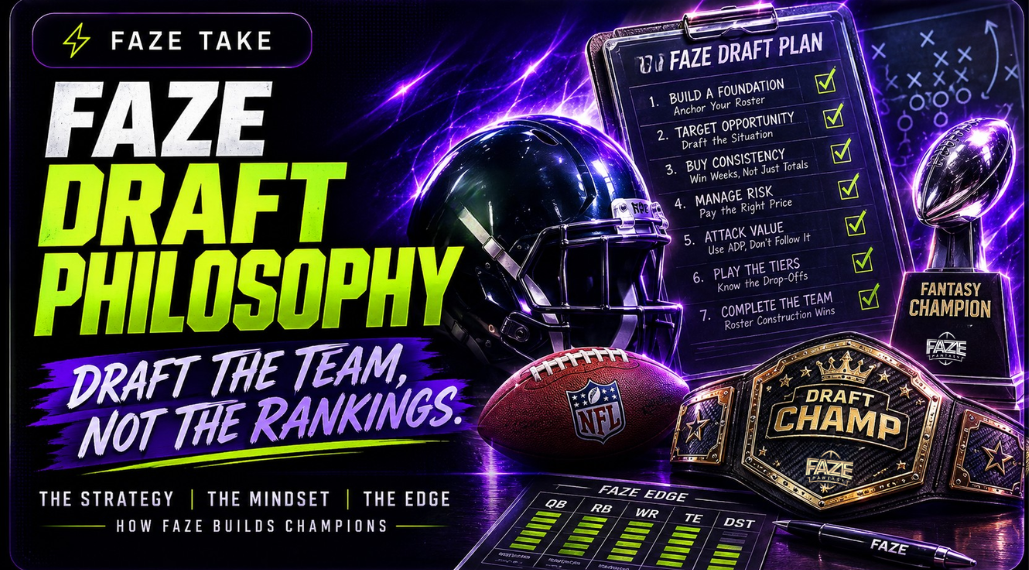
FAZE TAKE / Aug 12, 2026
FAZE Draft Philosophy
Draft the Team. Not the Rankings.
Every fantasy draft starts with a rankings sheet.
That doesn’t mean your draft should be controlled by one.
Rankings are useful. ADP is useful. Projections are useful. But none of them should make the decision for you.
The draft is about building a roster.
And building a roster requires something rankings alone cannot give you: context.
At FAZE, we don’t look at Player A versus Player B and simply ask which player is ranked higher.
We ask what that player is going to do for the team we’re building, what we’re paying to acquire him, how much risk we’re accepting, what his weekly production actually looks like, and what we may be giving up by passing on another position.
That changes everything.
ADP Is the Price. It Isn’t the Answer.
One of the biggest mistakes fantasy managers make is allowing ADP to become their draft board.
It isn’t.
ADP tells us what the market is charging.
That matters because every draft is a market. But the market does not determine how FAZE values the player.
A player going 35th overall isn’t automatically worth the 35th pick.
A player going 80th isn’t automatically less valuable than somebody going 55th.
The question is:
What am I buying at this price?
That’s why we compare market cost against our own evaluation.
If our valuation and the market agree, fine. That’s fair value.
If we believe a player should be selected earlier, we don’t sit around hoping he gets back to us simply because ADP says he should.
We attack the value.
And when the market gets too aggressive on a player we don’t trust, we’re willing to let somebody else draft him.
Fantasy drafts aren’t won by proving you can follow ADP.
They’re won by identifying where the market is wrong.
Build a Foundation Before You Chase Depth.
My first objective in a draft is not to fill every position evenly.
It’s to establish a foundation.
I want players early who can anchor my lineup and give me advantages that become increasingly difficult to find later.
That can mean being aggressive at running back.
It can mean taking a tight end earlier than conventional draft strategy recommends when I believe the talent, role and positional advantage are real.
It can mean securing an upper-tier quarterback before a meaningful drop-off.
And it can absolutely mean entering the middle rounds lighter at wide receiver than the typical roster-construction chart says I should be.
Why?
Because not every position has the same replacement curve.
I have historically been more comfortable finding wide receiver production later in drafts and throughout the season than finding an elite-workload running back, a difference-making tight end or certain high-level quarterbacks after those tiers disappear.
So I don’t draft positions just to make the roster look balanced after four rounds.
I draft scarcity, advantage and conviction.
Then I build around it.
Don’t Be Afraid to Draft Your Player.
There is a difference between reaching blindly and drafting with conviction.
If I believe a player belongs on my roster, I know the role is there, I believe in the environment, the price is reasonable and I don’t believe he will make it back to me, I’m willing to take him.
I don’t need ADP’s permission.
Sometimes the best selection isn’t the player sitting at the top of the queue.
It’s the player whose value to your roster is greater than his value to the market.
That matters because drafts aren’t played in a spreadsheet.
There are managers between every one of your picks.
There are positional runs.
There are tier breaks.
There are players you know won’t make it back.
And there are roster constructions that completely change what you need from the next selection.
A good drafter understands all of that.
Value isn’t just where a player is ranked. Value is what happens if you don’t take him.
Consistency Matters Because Fantasy Is Played Weekly.
This is one of the foundations FAZE was built around.
Season totals can lie.
A player can finish with a respectable fantasy total and still be incredibly difficult to own because too much of that production came from a handful of explosive games surrounded by losing weeks.
Fantasy football isn’t played at the end of the season.
It’s played every week.
That’s why we care so much about Hit Rate, Bust Avoidance, Boom Rate and Nuclear Rate instead of looking only at total fantasy points.
I want players who help me win weeks.
That doesn’t mean drafting eleven low-ceiling players because they’re “safe.”
We still want BOOMs.
We still want NUKES.
We still want players capable of breaking a matchup open.
But upside without reliability has a cost.
The best fantasy players give you both.
And when you’re comparing players in similar draft ranges, understanding how often each player actually gave you a usable fantasy week can expose differences that traditional rankings miss.
Risk Has to Be Purchased at the Right Price.
I don’t avoid risk.
Nobody wins a fantasy league by avoiding every uncertain player.
But I don’t believe in paying premium prices for unnecessary risk.
There’s a massive difference.
In the later rounds, uncertainty can be exactly what we’re looking for.
A player with an unsettled role, incomplete sample, injury recovery, rookie uncertainty or volatile profile can be an excellent selection when the acquisition cost is low and the potential return is high.
That’s asymmetric upside.
But if you’re asking me to spend an early-round pick on that same uncertainty, the equation changes.
The higher the acquisition cost, the more confidence I want in the player’s talent, role, opportunity and environment.
Your roster can absorb some volatility.
It cannot be built entirely on hope.
Draft the Situation, Not Just the Name.
Talent matters enormously.
But fantasy production does not happen in a vacuum.
We evaluate the player.
Then we evaluate everything surrounding the player.
Who’s the quarterback?
Who’s calling the plays?
What does the coaching staff prioritize?
Is the offensive line helping or hurting the situation?
What’s the expected game script?
Who’s competing for touches or targets?
Is the player getting goal-line opportunities?
Can he catch passes?
Is the offense expected to score?
Is the organization stable?
Is the role growing, shrinking or staying the same?
These things matter because opportunity and environment determine whether talent becomes fantasy production.
That is also why our Team Reports matter so much to the draft process.
We’re not evaluating 200 players as isolated names.
We’re evaluating 32 football environments and determining where fantasy production is most likely to come from inside them.
Know Why You’re Drafting the Player.
Every selection should have a reason.
Not:
“He was the highest-ranked guy left.”
Not:
“ESPN said this was a value.”
Not:
“Everybody seems to like him.”
Why are you drafting him?
Maybe he’s a foundational running back because the volume, passing-game usage and touchdown opportunity give him multiple paths to elite production.
Maybe he’s a receiver you’re targeting because the market hasn’t caught up to an expanding role.
Maybe he’s your tight end because you believe you’re buying a positional advantage before the talent tier collapses.
Maybe he’s a volatile receiver you’re taking later because your roster already has enough stability to absorb the risk.
Maybe he’s a running back you’re drafting almost entirely because an injury ahead of him could create a league-winning workload.
Those are draft decisions.
A ranking number isn’t.
Roster Construction Changes Player Value.
This is where draft strategy becomes more sophisticated than simply following a board.
The correct pick in Round 7 depends partly on what happened in Rounds 1 through 6.
If I’ve already built an extremely stable foundation, I can become more aggressive with upside.
If my early selections carry significant volatility, I may want more stability.
If I’ve secured quarterback and tight end advantages, I can attack running back and wide receiver without worrying about those positions.
If I’ve started running-back heavy, I already know wide receiver depth becomes a priority through the middle and later rounds.
The roster is constantly changing the decision.
That means draft strategy has to be dynamic.
There is no universal sequence of picks that produces the optimal team.
The board changes.
The room changes.
Your roster changes.
Your strategy has to change with it.
Understand Positional Drop-Offs.
Sometimes the most important player on the board isn’t the best player available.
It’s the last player in a tier.
If there are six wide receivers I consider comparable and one running back remaining before a significant drop, that matters.
If quarterback has several players I like and tight end has one, that matters.
If I know the wide receiver pool remains deep for another three rounds, that matters.
Good drafting isn’t just about identifying value.
It’s about understanding where value disappears.
That’s why target rounds and positional tiers matter more to me than rigid rankings.
I want to know when I need to act.
The Middle Rounds Are Where You Build the League Winner.
The early rounds should establish your foundation.
The middle rounds are where the draft starts becoming yours.
This is where preparation creates separation.
This is where we want players whose roles, environments and upside we believe the market hasn’t fully priced.
Ascending players.
Expanding roles.
Good players entering better environments.
Talented players coming off misleading seasons.
Backfields where opportunity could consolidate.
Receivers gaining target share.
Players whose underlying consistency was stronger than their final ranking suggests.
These aren’t random sleepers.
They’re calculated bets.
And by this point, roster construction matters even more.
You’re no longer just accumulating value.
You’re completing a team.
Late Rounds Are for Outcomes, Not Floor.
By the end of the draft, I’m not looking for players who can give me eight fantasy points if everything goes according to plan.
I can find eight fantasy points during the season.
Late-round selections should have a path to becoming substantially more valuable than the pick used to acquire them.
Give me the rookie whose role could explode.
The backup running back who could inherit significant volume.
The receiver who could become his team’s No. 2 option.
The ambiguous backfield.
The overlooked player in a strong offense.
The player whose talent exceeds his current opportunity.
Some of those picks are going to fail.
They’re supposed to.
The cost was low.
What matters is that when one hits, the return can materially change your roster.
Prepare Enough That the Draft Feels Slow.
The best draft preparation happens before you’re on the clock.
By draft day, I want to know the teams.
I want to know the depth charts.
I want to know the coaching changes.
I want to know the offensive lines.
I want to know the roles.
I want to know the injuries.
I want to know the market.
I want to know which players I trust, which players I’m willing to take ahead of market, which players I’ll draft only after they fall and which players I simply don’t want.
That’s the purpose of the work we do before draft day.
The goal isn’t to tell you who to pick without thinking.
The goal is to make sure you’re prepared enough to make the decision when it matters.
When the clock starts, I don’t want to begin researching.
I want to decide.
FAZE TAKE
There is no perfect draft strategy.
There is a draft philosophy.
Know what you’re buying. Know what it costs. Know what your roster needs. Know where the positional drop-offs are. Know which risks are worth taking. And know which players you’re willing to plant your flag on.
Use the market.
Don’t follow it.
Use rankings.
Don’t surrender to them.
Build consistency into the foundation of your roster, then add enough upside to win the league.
Pay for reliable opportunity when the price is high.
Buy uncertainty when the price is low.
Attack positional advantages when they exist.
Don’t draft a player just because he’s next.
And don’t pass on your guy because somebody else’s ADP says you’re eight picks early.
The entire FAZE philosophy comes back to one idea:
Better information should lead to better decisions.
But information alone doesn’t win drafts.
Judgment does.
The numbers give us evidence.
The Team Reports give us context.
The market gives us price.
The draft board gives us choices.
Then we make the call.
That’s FAZE draft strategy.
Draft the team. Not the rankings.