
FAZE Take
Native FAZE fantasy intelligence.
Better Data•Smarter Systems•Better Decisions
FAZE TAKE / Oct 30, 2026
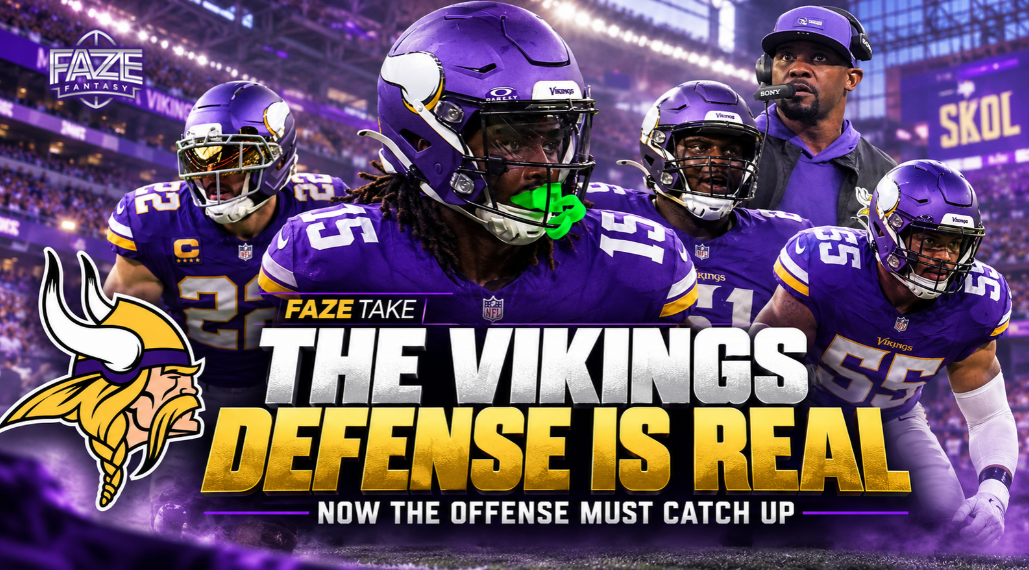
The Vikings Defense Is Real. Now the Offense Must Catch Up.
Minnesota is 6-0, riding an 11-game winning streak, and producing defensive numbers comparable to four legendary Super Bowl championship defenses. Brian Flores has built something special. The question is whether the Vikings offense can become good enough to finish what the defense has started.
Everybody seems to have an opinion about the Minnesota Vikings offense. Kyler Murray isn't producing enough. Justin Jefferson isn't getting the football enough. Kevin O'Connell needs to figure out how to get this offense moving. And eventually, everybody says, a really good quarterback and a really good football team are going to expose Minnesota.
Those concerns aren't entirely wrong. But they're missing the biggest story in Minnesota.
The Vikings are 6-0 because their defense is playing championship-caliber football. And the numbers suggest this might be something much bigger than a good six-game stretch.
Minnesota has now won 11 consecutive regular-season games dating back to 2025. The defense has been the foundation of that run, and Brian Flores deserves far more recognition for what he's building.
A Defense in Historic Company
Through six games in 2026, Minnesota has allowed just 74 points and 1,517 total yards. That's 12.3 points and 252.8 yards per game. The Vikings have recorded 21 sacks, forced 11 turnovers and held opponents to a 28.2% conversion rate on third down. They're first in the NFL in scoring defense, second in yards allowed and tied for first in sacks.
But here's where those numbers become particularly interesting.
| Defense | Points Allowed/Game | Yards Allowed/Game |
|---|---|---|
| 2000 Baltimore Ravens | 10.3 | 247.9 |
| 2002 Tampa Bay Buccaneers | 12.3 | 252.8 |
| 2026 Minnesota Vikings | 12.3 | 252.8 |
| 1985 Chicago Bears | 12.4 | 258.4 |
| 2013 Seattle Seahawks | 14.4 | 273.6 |
Minnesota's figures are through six games. Historical figures represent completed regular seasons.
Look at those numbers. Minnesota is allowing virtually the same points and yards per game as the 2002 Buccaneers, whose defense helped deliver a Super Bowl championship. The Vikings' scoring pace is slightly better than the legendary 1985 Chicago Bears, and their yards allowed per game are lower than both the Bears and the 2013 Seattle Seahawks.
And there's something especially compelling about those four historical defenses.
Every single one won the Super Bowl in the very season we're comparing.
The 1985 Chicago Bears won Super Bowl XX, dismantling New England 46-10. The 2000 Baltimore Ravens won Super Bowl XXXV, defeating the New York Giants 34-7. The 2002 Tampa Bay Buccaneers won Super Bowl XXXVII, crushing Oakland 48-21. And the 2013 Seattle Seahawks won Super Bowl XLVIII, overwhelming Peyton Manning and Denver's record-setting offense 43-8.
Four defenses remembered among the greatest in NFL history. Four dominant defensive seasons. Four Super Bowl championships.
That's not a coincidence worth overlooking. These weren't simply excellent defenses that accumulated impressive statistics during the regular season. They helped carry their teams to championships, demonstrating just how much an elite defense can influence the outcome of an entire season.
Now, six games don't make a historically great defense. Those teams sustained their performances over an entire season and ultimately delivered championships. Minnesota still has a long way to go.
But dismissing the comparison simply because the season isn't over would be missing the point. This Vikings defense has earned the right to be measured against elite historical standards. The question is whether it can sustain them.
Brian Flores Is Playing a Different Game
If you want one statistic that explains what makes Minnesota so dangerous, consider this: the Vikings have allowed just three fourth-quarter points through six games.
Three points across six fourth quarters of football. Opposing offenses have had opportunities to study Minnesota's tendencies, make halftime adjustments and identify potential weaknesses, yet the Vikings have consistently become more difficult to score against as games progress.
That brings us to Brian Flores and something about his defensive philosophy that I believe doesn't receive nearly enough attention.
Good quarterbacks study defenses. Great quarterbacks adjust to them. They recognize coverages, identify pressure tendencies and work with their offensive coordinators to develop answers throughout the game. By the second half, the objective is to have a better understanding of what the defense wants to accomplish.
But Flores doesn't make that process easy. His defense is built around disguise, uncertainty, changing pressure looks and making quarterbacks question what they're seeing before the snap. He can show pressure and drop into coverage, bring defenders from unexpected locations or make a quarterback believe he has identified the blitz before changing the picture entirely.
Here's what I believe makes Flores particularly dangerous: he isn't simply forcing quarterbacks to adjust to his defense. He's continually adjusting his defensive presentation to what quarterbacks and offenses are trying to do.
The same personnel and formations can create entirely different problems as the game progresses. An offense thinks it has found an answer, only for Flores to change the question. That constant uncertainty makes it extraordinarily difficult for quarterbacks and offensive coordinators to develop a consistent rhythm.
And Minnesota's fourth-quarter results are a powerful reflection of how effective that approach has become.
Caleb Williams: A Fascinating Example
Consider Caleb Williams and his five career meetings against a Brian Flores defense.
In his first matchup against Minnesota in November 2024, Williams posted a 103.1 passer rating, throwing for 340 yards and two touchdowns. In the next four meetings, his passer ratings were 86.9, 86.6, 68.9 and, most recently, just 56.3 in Week 2 of this season.
That's five consecutive meetings with a lower passer rating than the previous matchup.
In their latest meeting, Williams managed just 138 passing yards, no touchdowns and an interception before leaving with an injury. Minnesota won 9-3.
Of course, injuries, personnel and game circumstances influence quarterback performance. But the broader trend is fascinating. Williams has gained experience and familiarity with Flores' defense, yet his statistical results have steadily declined.
Normally, a quarterback should become more comfortable recognizing a defensive coordinator's tendencies with repeated exposure. Against Flores, Williams has experienced the opposite.
To me, that's a compelling example of just how difficult this defensive system can be to solve.
FAZE Saw Dallas Turner Coming
One of the most satisfying developments of Minnesota's season has been watching Dallas Turner emerge as the player FAZE identified before the season started.
In our 2026 Minnesota Vikings Gold Standard Team Report, we highlighted Turner as a potential breakout player entering his third season. The departure of Jonathan Greenard created an opportunity for Turner to assume a larger role in Flores' defense, and we believed his talent, development and expanded opportunity could translate into a significant leap.
That's exactly what we're watching unfold.
Turner has six sacks through six games, tied for third in the NFL entering Week 8. He also has two forced fumbles and has emerged as one of Minnesota's most disruptive defensive players.
This isn't identifying a player after he starts producing. FAZE identified the opportunity before the production arrived.
Greenard was a legitimate loss. Minnesota traded a proven edge rusher who had recorded 12 sacks during his first Vikings season in 2024. But the remarkable thing is that the Vikings' pass rush hasn't suffered the way many might have expected. With Turner breaking out, Andrew Van Ginkel contributing four sacks and Blake Cashman adding 4.5, Minnesota has continued generating pressure from multiple positions.
And the Vikings made other moves that helped strengthen this unit beyond the raw numbers.
The addition of Kyle Van Noy brought an experienced veteran who already understood Flores' defensive philosophy from their time together in New England and Miami. A two-time Super Bowl champion, Van Noy provides familiarity, versatility and veteran leadership within a demanding defensive system.
Then there's Harrison Smith.
After uncertainty over whether he would return for a 15th season, Smith decided to come back. His understanding of opposing offenses, knowledge of the system and ability to communicate and organize the defense are qualities that don't always appear on a stat sheet.
Against Indianapolis last Sunday, Smith provided another reminder of his value. With Minnesota protecting a six-point lead late in the fourth quarter, he intercepted Daniel Jones for the 40th interception of his career, effectively ending the game and securing Minnesota's sixth victory.
That combination of emerging talent, experienced veterans and coaching continuity has made this defense something special. Turner is becoming a difference-maker, but he's doing it within a system that creates opportunities for the entire unit.
Fantasy Managers: No Busts, Just Production
From a fantasy football standpoint, Minnesota has become one of the most dependable defenses in the league.
Through six games, the Vikings have scored 8, 17, 17, 8, 11 and 10 fantasy points in standard DST scoring. That's 71 points, an average of 11.8 per game, and not a single performance below eight points.
Using FAZE's DST outcome thresholds, that's four HIT performances, two BOOM weeks and zero BUSTS.
Minnesota hasn't simply provided upside. It has delivered an incredibly reliable weekly floor, and that's especially valuable at a fantasy position where managers frequently chase matchups and unpredictable defensive touchdowns.
For season-long fantasy managers, the Vikings have earned the status of a defense you can generally start with confidence instead of continually searching the waiver wire for another streaming option.
From a DFS perspective, Minnesota offers the combination of sacks, takeaways and scoring prevention that creates a legitimate ceiling. Matchups, salary and projected ownership still matter, particularly against explosive offenses, but this is a defense whose reliability deserves serious consideration every week.
And that brings us to Detroit.
Detroit Is the Test Everyone Has Been Waiting For
Sunday's matchup against the Lions is exactly the kind of challenge people have been talking about.
Detroit enters at 4-2, averaging 30.7 points and 397.3 yards per game. Jared Goff has thrown 14 touchdowns without an interception, and his ability to diagnose pressure and distribute the football quickly makes him a serious challenge for any defense.
But let's not pretend Detroit hasn't experienced what Flores can do.
Minnesota swept the Lions in 2025, winning 27-24 in Detroit and 23-10 at home on Christmas Day. In the first meeting, the Vikings held Detroit to just 65 rushing yards and sacked Goff five times. In the second meeting, Goff threw for 197 yards, one touchdown and two interceptions while Minnesota again recorded five sacks and forced six total turnovers.
Detroit knows exactly how disruptive this defense can be.
And despite the perception that Detroit has recently controlled this rivalry, the teams have split their last four meetings, with Detroit sweeping in 2024 and Minnesota returning the favor in 2025. Historically, the Vikings lead the all-time series 82-45-2 entering Sunday.
This is an NFC North rivalry with decades of history, and both teams understand the significance of this matchup.
Goff is an excellent quarterback and a legitimate test for Minnesota's defensive philosophy. But Flores has already demonstrated that he can make life extremely difficult for this quarterback and this offense.
Detroit should be respected. Minnesota shouldn't be intimidated.
The Offense Has to Meet the Defense Halfway
Here's where I believe the legitimate concern lies.
Minnesota is undefeated despite an offense averaging just 20.8 points and 281.7 yards per game. That's not the kind of production you'd expect from a team with Justin Jefferson, Jordan Addison, T.J. Hockenson, Aaron Jones and a quarterback with Kyler Murray's talent.
But the offensive situation deserves context.
Murray's Vikings debut ended after just 11 offensive snaps because of a concussion. Carson Wentz replaced him in Week 1 and started Week 2. Murray returned in Week 3 and has been working to establish chemistry and familiarity with Kevin O'Connell's offense.
Injuries have repeatedly disrupted the offensive personnel as well. Last week's game against Indianapolis represented an important step toward getting more of Minnesota's primary skill-position players back on the field together, although offensive-line injuries remained an issue. Even then, Aaron Jones suffered another knee injury, creating uncertainty about his availability against Detroit.
I believe Murray can continue improving in this offense. But I also believe O'Connell needs to adapt more of the offense to Murray's strengths rather than expecting Murray to operate exclusively within the existing structure.
Give him quick hitters. Create designed movement. Get him outside the pocket with purpose. Use his mobility to change defensive angles and create easier throwing opportunities. Murray doesn't need to abandon the structure of the offense, but the offense should take greater advantage of what makes him dangerous.
And most importantly, get Justin Jefferson the football.
Through six team games, Jefferson has just 23 receptions for 302 yards. That's not enough involvement for one of the premier receivers in football.
I want Jefferson seeing approximately 10 targets per game as a weekly offensive priority. Not forced throws into double coverage, but designed opportunities. Quick slants, shallow crosses, intermediate routes, motion and opportunities to catch the football in space. Make defenses defend Jefferson horizontally and vertically, and force them to account for him before and after the snap.
That attention can help open opportunities for Addison and Hockenson.
Hockenson has shown encouraging signs of renewed involvement, including his 13-catch performance against Miami and the decisive fourth-quarter touchdown against Indianapolis. He's becoming an important option for Murray, and that's something Minnesota can continue building upon.
The running game is equally important. Minnesota needs to establish a credible rushing threat, remain ahead of the chains and avoid constantly putting Murray in obvious passing situations. Jones and Jordan Mason can provide that foundation when healthy, while Murray's mobility creates another element opposing defenses must respect.
There's enough talent here for the offense to be considerably better than it has been. And if Minnesota can get that offense functioning consistently, the Vikings become a much more dangerous football team.
Final FAZE Take: Defense Wins Championships
I'm buying this Minnesota defense.
Not simply because the Vikings are undefeated, and not because I'm ready to declare them the next 1985 Chicago Bears. I'm buying them because of how they're winning football games.
They're pressuring quarterbacks, forcing turnovers, disrupting offensive timing, limiting scoring opportunities and shutting opponents down when games matter most. They're getting production from players FAZE identified before the season, veterans who understand the system and a defensive coordinator who continues to create problems even for experienced quarterbacks.
Eleven consecutive wins aren't an accident.
And the historical comparisons deserve attention. The 1985 Bears, 2000 Ravens, 2002 Buccaneers and 2013 Seahawks didn't just establish themselves as historically great defenses. Every one of them won the Super Bowl that season.
That's the company Minnesota is beginning to keep statistically. And if this defense continues performing at this level throughout the season, the Vikings deserve to be part of a serious championship conversation.
But let's pump the brakes before crowning anybody.
After all, this is Minnesota we're talking about, and Vikings fans know better than most that regular-season greatness doesn't guarantee postseason success. In 1998, Minnesota finished 15-1 behind one of the most explosive offenses in NFL history, becoming the first team ever to win 15 regular-season games and still fail to reach the Super Bowl. That season ended with a heartbreaking overtime loss to Atlanta in the NFC Championship Game.
If there's one lesson Vikings history has taught us, it's that making history during the regular season and finishing the job in January are two entirely different things.
Six games into 2026, there's still a tremendous amount of football to be played. Sunday's matchup against Detroit will provide another important measuring stick, but I don't believe one game should determine how we evaluate everything this defense has already accomplished.
My expectation is that Minnesota's defense will remain one of the NFL's best throughout the season, provided its key players stay healthy. The bigger question is whether the offense can develop the consistency necessary to complement it. Murray needs to continue growing within O'Connell's system. Jefferson needs more involvement. The running game must become dependable. And the Vikings have to stop asking their defense to carry so much of the responsibility for winning games.
The Vikings defense is real. The historical comparisons are real. But championships aren't won through comparisons. They're earned on the field.
Minnesota still has plenty to prove before anyone should start talking about a Super Bowl parade. But there's no denying what this team has accomplished or the direction it's heading.
For a franchise with its share of postseason heartbreak, this defense is giving Vikings fans something worth believing in.
The offense still has to catch up. But six games into the season, Minnesota fans have every reason to be excited about what this team could become.
— FAZE Fantasy