
Tuesday Morning Intelligence Briefing
The NFC North’s first padded practices have begun separating meaningful fantasy developments from early-camp noise.
Detroit’s most important player has now missed five consecutive practices during a contract hold-in, creating legitimate contingency value behind Jahmyr Gibbs. Green Bay has reopened Tucker Kraft’s path toward Week 1 while Jordan Love’s receiver hierarchy begins taking shape. Minnesota’s quarterback competition remains unresolved, although recent practice trends have begun favoring Kyler Murray. Chicago is showing both an ascending Caleb Williams–Colston Loveland connection and a backfield that should remain divided between D’Andre Swift and Kyle Monangai.
The stories below are ordered by current fantasy importance.
NFC North Roster Context
Chicago’s verified offensive roster includes Caleb Williams, D’Andre Swift, Kyle Monangai, Rome Odunze, Luther Burden III, Colston Loveland, Cole Kmet and Kalif Raymond.
Detroit’s current fantasy core includes Jared Goff, Jahmyr Gibbs, Isiah Pacheco, Amon-Ra St. Brown, Jameson Williams and Sam LaPorta. Gibbs remains on the active roster and is attending camp despite not participating in practice.
Green Bay’s verified group includes Jordan Love, Josh Jacobs, Matthew Golden, Christian Watson, Jayden Reed, Tucker Kraft, Luke Musgrave and MarShawn Lloyd.
Minnesota’s roster includes Kyler Murray, J.J. McCarthy, Justin Jefferson, Jordan Addison, Jauan Jennings, T.J. Hockenson, Aaron Jones and Jordan Mason.
Team Tags
LIONS
Gibbs’ Hold-In Has Reached the Point Where the Missed Work Matters
Affected players
Gibbs missed his fifth consecutive practice Monday while seeking a long-term contract. He has remained with the team and was seen interacting with teammates, but he declined to establish a timetable for returning to the field. Gibbs is entering his fourth NFL season after producing 1,223 rushing yards, 77 receptions, 616 receiving yards and 18 total touchdowns in 2025.
Detroit has continued installing its offense without him. Pacheco and Sione Vaki received increased first-team opportunities during the opening practices, with Dan Campbell describing the additional work as valuable for getting Pacheco comfortable in Detroit’s system. The Lions signed Pacheco to serve as the primary back behind Gibbs after David Montgomery’s departure.
The rest of Detroit’s passing ecosystem is producing positive signals. Jameson Williams has repeatedly made plays beyond traditional vertical routes, including a 20-yard comeback conversion on third-and-10. Detroit’s staff has praised the increased definition and detail in his route running after consecutive 1,000-yard seasons.
Goff has also continued distributing the ball among St. Brown, Williams and LaPorta during situational periods. LaPorta opened camp healthy after last season’s injury and enters an offense coordinated by Drew Petzing, whose system has historically created substantial tight-end involvement.
FAZE Take
This is not yet a reason to move Gibbs out of the elite running-back tier.
It is no longer meaningless, either.
Gibbs does not need routine camp carries to prove his talent. He does need time in a revised offense with a new coordinator, a changed offensive line and a new backfield partner. Every missed padded practice gives Pacheco more experience with the first unit and makes Detroit increasingly comfortable operating without its star back.
That matters for two separate projections.
First, Gibbs’ contract situation introduces availability risk. There is currently no firm indication that the hold-in will extend into the regular season, but there is also no announced return date.
Second, Pacheco is earning legitimate contingency value. He is not simply standing behind Gibbs on a depth chart. He is receiving the installation work that would allow Detroit to use him immediately if Gibbs misses time or begins the season with a managed workload.
The passing game is quietly benefiting from the situation. Goff is receiving additional repetitions with Williams, LaPorta and the secondary receivers while Detroit’s offense operates without its most dynamic player.
Fantasy Action
Team Tags
PACKERS
Kraft’s Return Reopens the Breakout Path as Love’s Target Structure Takes Shape
Affected players
Green Bay activated Kraft from the physically unable to perform list on July 31. He initially participated only in individual drills and walkthrough periods, marking his first on-field work since tearing his ACL last November. The Packers have not yet cleared him for unrestricted team periods.
Kraft had emerged as one of the league’s most productive tight ends before the injury, catching 32 passes for 489 yards and six touchdowns in eight games. His 15.3 yards per reception reflected the catch-and-run ability that separated him from conventional underneath tight ends.
While Kraft progresses, Love’s receiver structure is becoming clearer.
During Monday’s first full-pads practice, Love connected multiple times with Golden on comeback routes, found Watson on two deep in-breaking routes and hit Reed for a long touchdown when the coverage broke down. Love later completed passes to Watson and Reed during a two-minute drill.
Golden has been working primarily at the X receiver position, giving him a potential full-time perimeter role. Watson has already produced multiple red-zone touchdowns during camp after returning from last season’s ACL injury, while Reed continues to move throughout the formation as Green Bay’s most versatile receiver.
FAZE Take
Kraft’s activation is one of camp’s most important tight-end developments.
It does not mean his recovery is complete.
The Packers have reopened his path to Week 1, but the next step remains full-speed team participation. Kraft still needs to run routes against live coverage, block through contact and stack consecutive practices without swelling or workload reduction.
The receiving structure around him is also more defined than it initially appeared.
Golden is beginning to look like the traditional outside receiver. Watson supplies vertical speed and scoring-area size. Reed remains the movable explosive piece who can win from the slot, through motion or after the catch.
That structure can help Love without necessarily creating a massive target share for one receiver. Green Bay may become a stronger passing offense while remaining difficult to project on a week-to-week basis.
Kraft can solve part of that problem. If healthy, he provides Love with a reliable middle-of-the-field target whose yards-after-catch ability allows short throws to become explosive gains.
Fantasy Action
Team Tags
VIKINGS
Murray Is Beginning to Gain Ground, but Minnesota Has Not Closed the Competition
Affected players
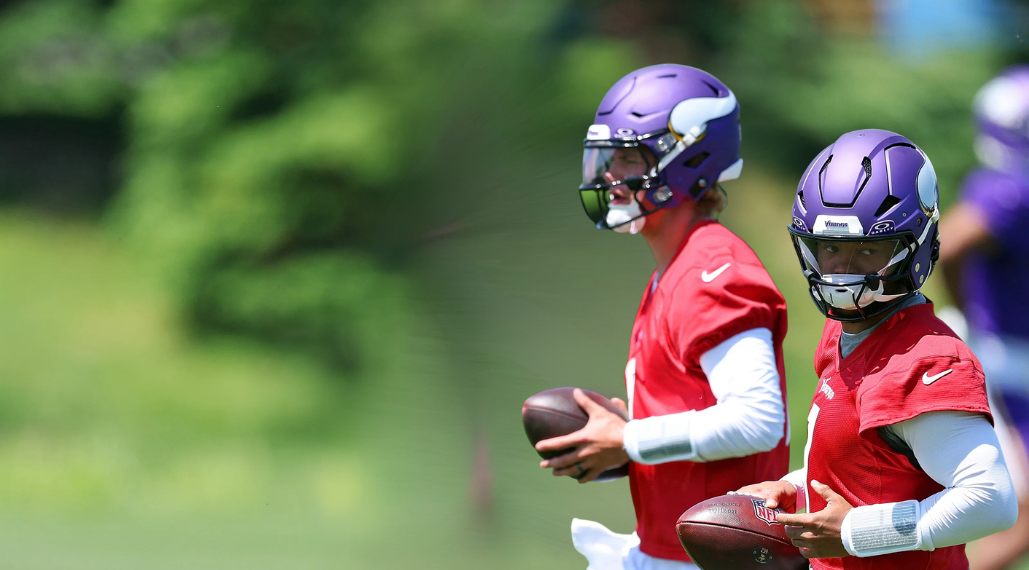
Murray and McCarthy continued rotating with Minnesota’s starters during Monday’s first padded practice. The Vikings’ defense controlled much of the session, and both quarterbacks failed to finish their final two-minute opportunities. Minnesota has not named a starter.
The recent trend, however, has begun moving toward Murray.
Murray held the advantage during Saturday’s open practice and received the majority of first-team full-team repetitions during a stronger offensive session. Observers have noted increased comfort, touch and decisiveness as he becomes more familiar with Kevin O’Connell’s offense.
Jefferson remains central to the evaluation. Murray has connected with him while extending plays and working across the middle, while both quarterbacks spent portions of the offseason building timing with Minnesota’s lead receiver.
The running game offered limited clarity Monday. Minnesota’s defensive front controlled the run-focused periods, including a tackle for loss against Mason. Aaron Jones and Mason remain the roster’s primary veteran backs, with Mason bringing the more physical rushing profile.
FAZE Take
Minnesota does not need to force a quarterback announcement after five camp practices.
Fantasy managers do need to understand what each outcome means.
Murray starting would immediately add proven rushing production, off-script creation and veteran experience to the offense. His ability to extend plays could produce additional explosive opportunities for Jefferson and create easier middle-of-the-field targets for Hockenson.
McCarthy winning would preserve continuity with O’Connell’s system but introduce more weekly variance. He must demonstrate improved accuracy, processing speed and command against pressure before the entire passing game can be projected confidently.
Jefferson remains quarterback-resistant. His talent and target priority protect his value under either outcome.
The secondary pass catchers are more sensitive to the decision. Hockenson, Addison and Jennings need consistent timing and sustained drives. A prolonged competition reduces the number of first-team repetitions each quarterback receives with those players.
The backfield also remains unsettled. Jones and Mason can form an effective combination, but their individual value depends on who receives passing-down, short-yardage and scoring-area work.
Fantasy Action
Team Tags
BEARS
The Loveland Connection Is Growing, but Chicago’s Backfield Remains a Two-Man Operation
Affected players
Williams and Loveland have produced one of Chicago’s strongest early camp connections.
During Friday’s two-minute period, Williams completed three passes to Loveland in four plays and finished the possession with a 14-yard touchdown to the second-year tight end. Earlier practices also featured Williams repeatedly finding Loveland alongside Odunze and Burden.
Loveland is coming off a rookie season in which he led Chicago with 713 receiving yards and added 193 yards during two playoff games. Williams has publicly described Loveland as capable of becoming one of the league’s best tight ends.
Chicago’s running game presents a different kind of fantasy signal. The Bears ranked third in rushing last season at 144.5 yards per game, with Swift producing 1,087 yards and Monangai adding 783. They were the NFL’s only teammates to each exceed 750 rushing yards.
Monangai returned Monday after missing the first four practices with a soft-tissue injury. Ben Johnson said Chicago intends to monitor Swift’s camp workload to keep him fresh while continuing to challenge him in the passing game.
Kmet remains part of the offense but acknowledged that his responsibilities increasingly include blocking and pass protection. He recorded only 30 receptions for 347 yards last season as Loveland became the more productive receiving tight end.
FAZE Take
Loveland is becoming more than another good player in a deep receiving group.
He is becoming Williams’ problem-solver.
That distinction matters. Odunze and Burden can win outside and create explosive plays, but Loveland can become available quickly over the middle, adjust against zone coverage and provide a large target when Williams extends a play.
His concentrated two-minute usage is particularly important. Quarterbacks reveal trust when they repeatedly return to the same target during compressed, situational periods.
Kmet’s continued presence will keep Loveland from playing every tight-end snap, but the fantasy roles are separating. Kmet provides blocking, protection and formation versatility. Loveland is becoming the primary receiving threat.
The backfield is less likely to produce a dramatic separation.
Swift is the established starter and superior receiving option. Monangai has already shown that he can handle meaningful rushing volume. Chicago’s own 2025 production demonstrated that both backs can remain heavily involved.
This should be evaluated as a productive committee—not a competition that must eventually produce one winner.
Fantasy Action
Team Tags
49ERS
San Francisco’s Receiver Situation Becomes Even More Fragile
Ricky Pearsall has been placed on season-ending injured reserve and will undergo surgery on the PCL injury that resurfaced during training camp. San Francisco re-signed Deebo Samuel after determining Pearsall would miss the season.
Mike Evans then missed Monday’s practice with a quadriceps strain, adding another concern to a receiver room already managing injuries to Pearsall, Christian Kirk and De’Zhaun Stribling. The current indication is that Evans’ injury is not believed to be severe, but San Francisco has not provided a firm return date.
Samuel’s immediate opportunity continues to rise. Pearsall’s absence created the opening; Evans’ and Kirk’s short-term injuries increase Samuel’s installation work and his chance to establish a larger role before the offense becomes healthy.
Evans should not receive a substantial downgrade for a reportedly minor strain, but his age and soft-tissue history make the duration worth monitoring.
Trey Benson’s Surgically Repaired Knee Flares Up
Arizona held Benson out after he experienced discomfort in his surgically repaired knee. Head coach Mike LaFleur said the Cardinals are proceeding cautiously, and Arizona added running back Evan Hull through waivers Monday.
Benson’s path to a larger role is temporarily on hold. James Conner’s starting projection becomes more secure, while Benson must prove that he can return to full-speed work without recurring discomfort.
This is not yet a confirmed long-term absence, but any setback involving the same knee requires a medical discount until Benson resumes consecutive practices.
Team Tags
Tuesday FAZE Watchlist
Final FAZE Read
Detroit owns the division’s most urgent fantasy situation.
Gibbs remains one of the most valuable players in fantasy football, but five missed practices have moved the story beyond harmless contract theater. Pacheco is receiving meaningful installation work, and his contingency value is rising with every day Gibbs remains out.
Green Bay produced the division’s strongest positive health development. Kraft is back on the field, reopening a breakout path that appeared uncertain when camp began. The Packers are also beginning to show a functional receiver structure around Golden, Watson and Reed.
Minnesota’s quarterback competition is gradually tilting toward Murray without being officially decided. His experience and rushing ability would raise the stability and scoring ceiling of the entire offense, especially for Hockenson and the secondary receivers.
Chicago’s most important development is the growing trust between Williams and Loveland. The backfield, meanwhile, should be treated as a genuine committee after Swift and Monangai both produced substantial workloads last season.
Tuesday morning priority: Gibbs’ continued absence first, Kraft’s recovery and Green Bay’s target hierarchy second, Minnesota’s quarterback competition third and the Williams–Loveland connection fourth.
Team Tags
FAZE Feed Archive
Previous Editions
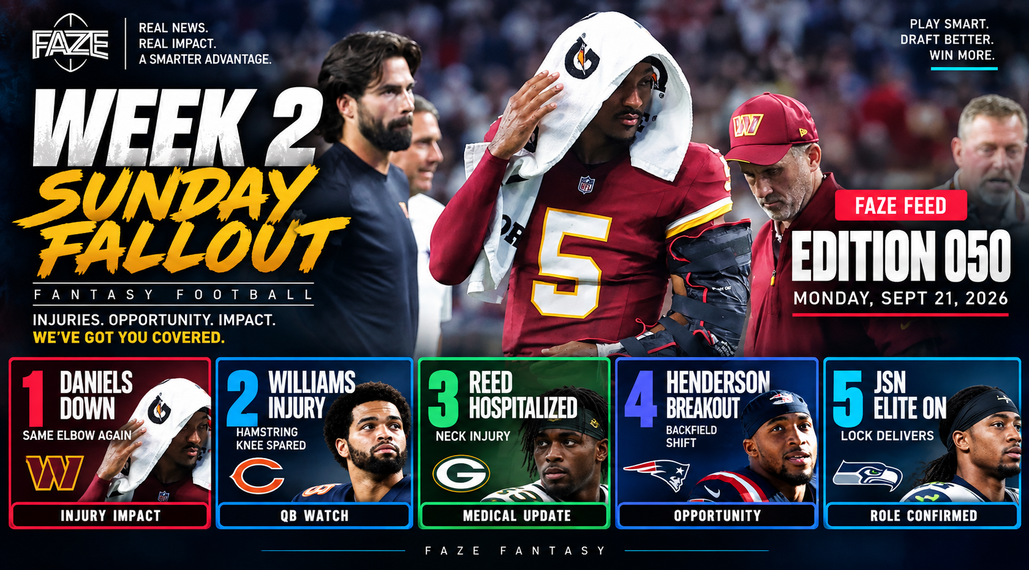 Edition 050 • September 21, 2026WEEK 2
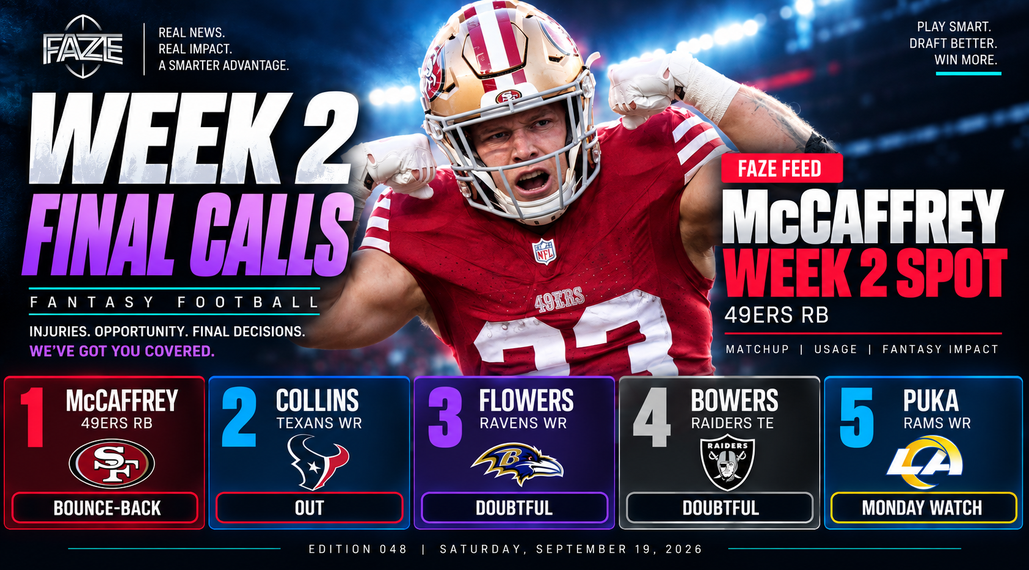 Edition 048 • September 19, 2026WEEK 2
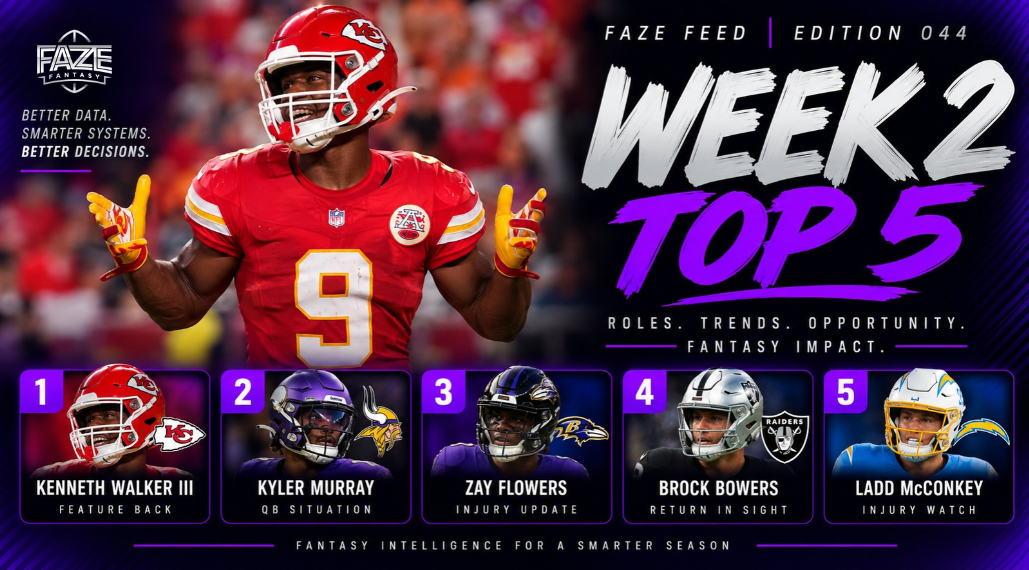 Edition 044 • September 15, 2026WEEK 2Edition 040 • September 12, 2026FINAL CALL
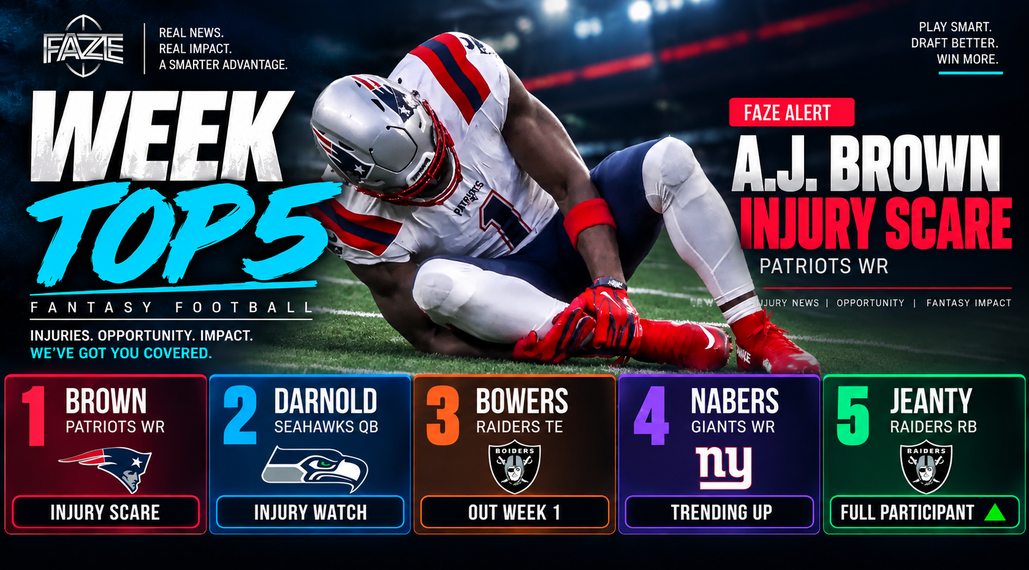 Edition 039 • September 10, 20262026 NFL Regular Season — Week 1
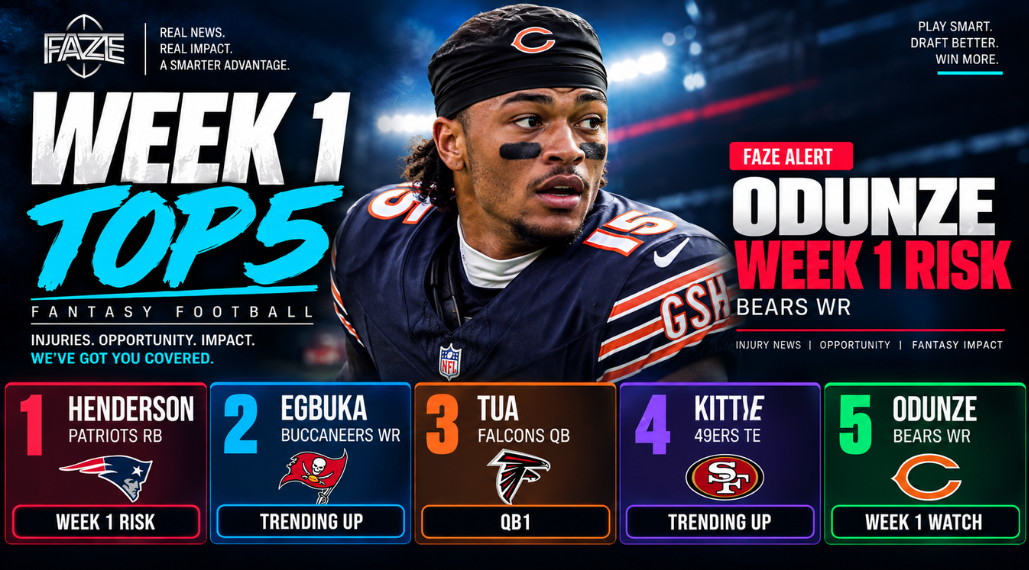 Edition 037 • September 8, 20262026 NFL Regular Season — Week 1
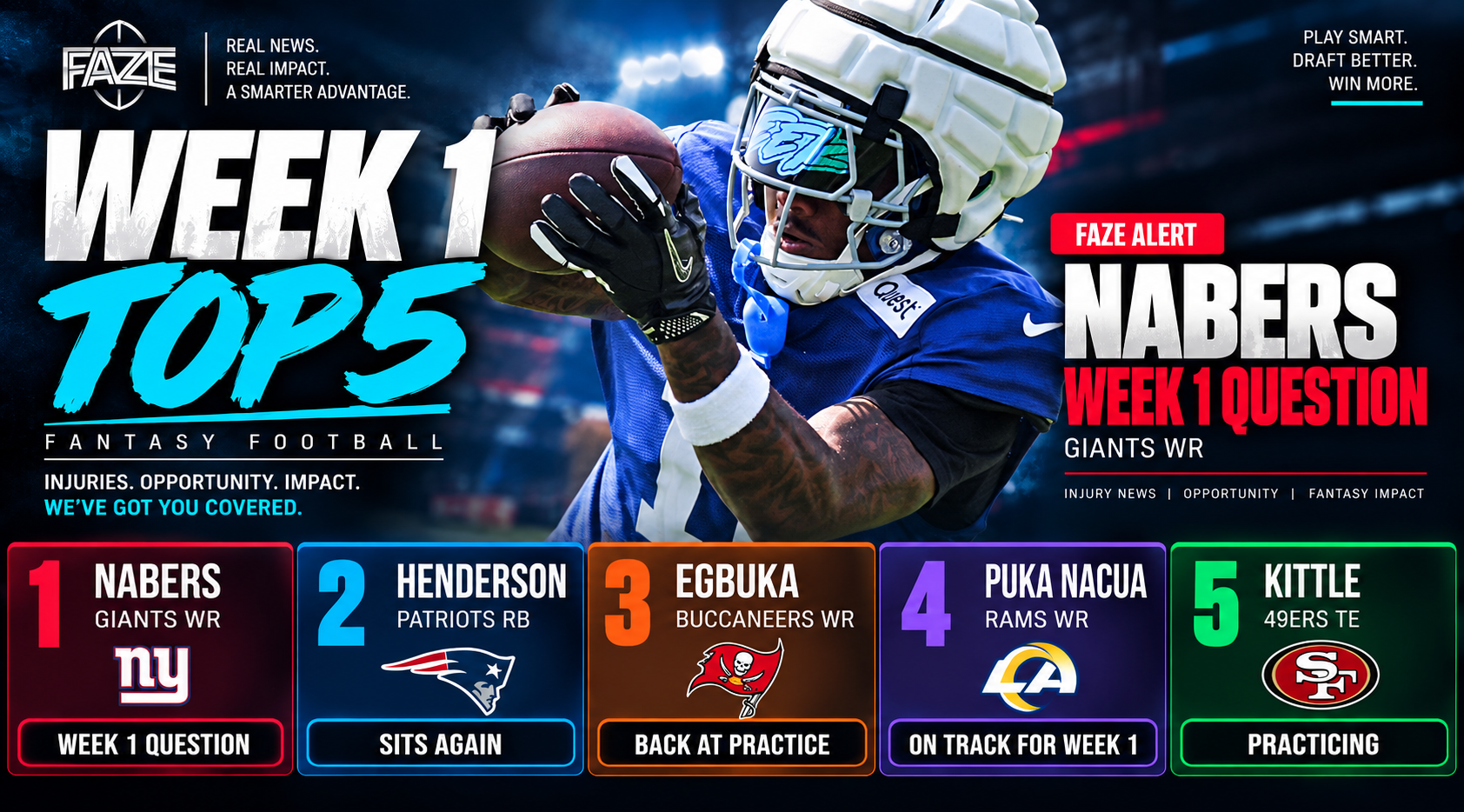 Edition 036 • September 7, 20262026 NFL Regular Season — Week 1
 Edition 035 • September 6, 2026League-wideEdition 031 • September 2, 2026League-wideEdition 030 • September 1, 2026League-wideEdition 029 • August 31, 2026League-wideEdition 028 • August 28, 2026League-wideEdition 027 • August 27, 2026League-wideEdition 026 • August 26, 2026League-wideEdition 025 • August 25, 2026League-wideEdition 024 • August 23, 2026League-wideEdition 023 • August 16, 2026League-wideEdition 022 • August 15, 2026League-wideEdition 021 • August 14, 2026League-wideEdition 020 • August 12, 2026League-wideEdition 019 • August 11, 2026League-wideEdition 018 • August 10, 2026AFC NorthEdition 017 • August 8, 2026AFC EastEdition 016 • August 6, 2026NFC SouthEdition 015 • August 5, 2026NFC WestEdition 014 • August 4, 2026 • CurrentNFC NorthEdition 013 • August 3, 2026AFC West + AFC SouthEdition 012 • July 30, 2026NFC WestEdition 011 • July 29, 2026NFC NorthEdition 010 • July 28, 2026NFC EastEdition 009 • July 27, 2026AFC NorthEdition 008 • July 26, 2026AFC SouthEdition 007 • July 25, 2026AFC WestEdition 006 • July 24, 2026AFC EastEdition 005 • July 23, 2026NFC SouthEdition 004 • July 22, 2026NFC WestEdition 003 • July 21, 2026NFC NorthEdition 002 • July 20, 2026NFC EastEdition 001 • July 19, 2026League-wide